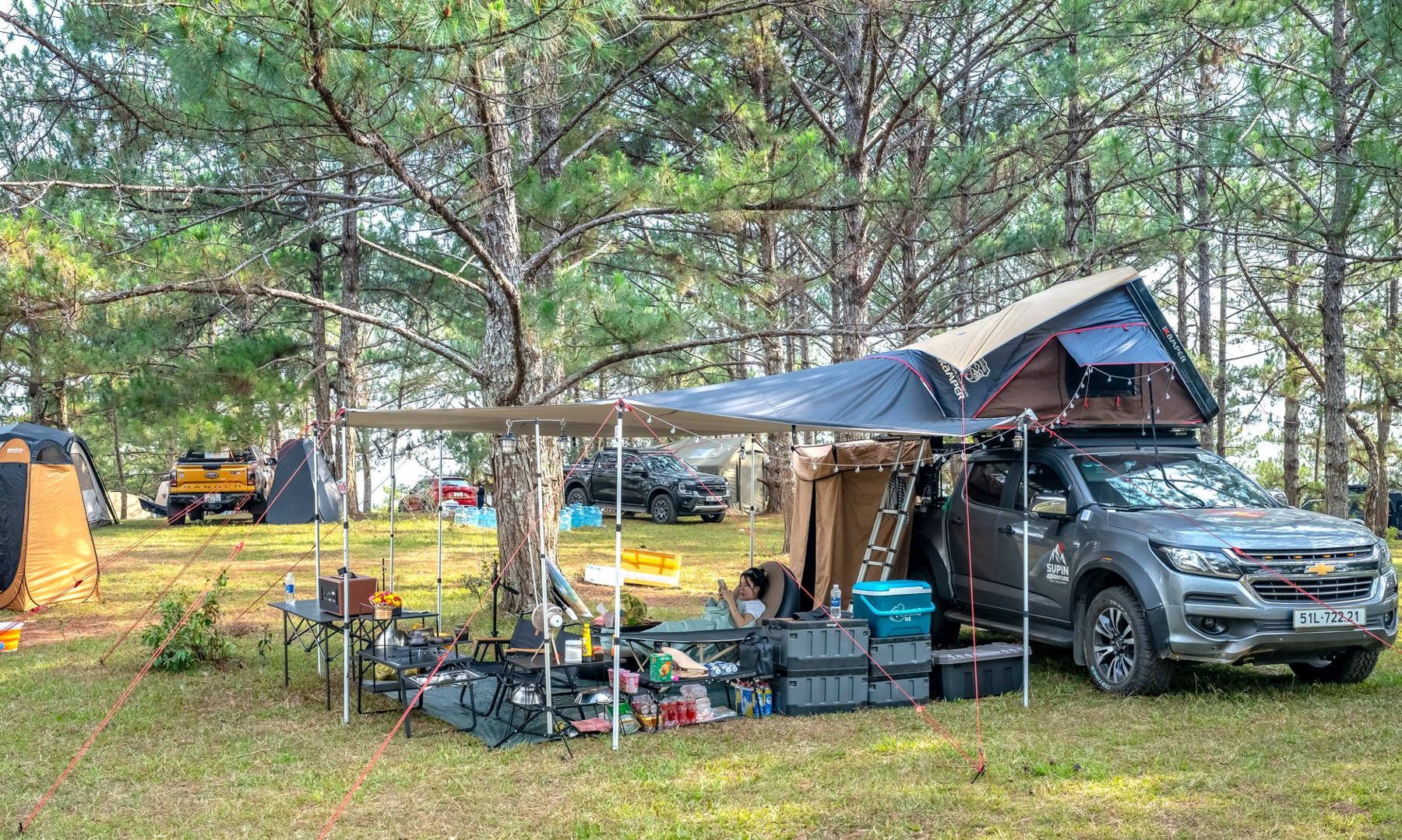
Two phones, a rechargeable lantern, and a camera can make a modest power station useful for a weekend. Add a cooler or an electric blanket, and the same battery may fall short. Before choosing a capacity, list what needs power, how long you will use it, and whether you can recharge during the trip.
Start with a two-night stay: arrive Friday evening, leave Sunday afternoon, and assume there is no campsite outlet. That gives you a clear planning window. Size the battery around the energy you expect to use between charging opportunities, with a reserve for changes in plans.
1. Separate energy capacity from output power
A power station has two ratings that answer different questions. Watt-hours (Wh) describe stored energy. Watts (W) describe how quickly a device uses energy or how much power an output can supply at one time.
The basic calculation is:
Energy in Wh = power in W × operating time in hours.
A light drawing 5 W for four hours uses 20 Wh. A device drawing 50 W for four hours uses 200 Wh. These are calculation examples, not claims about the equipment in your camp.
A station with enough stored energy can still fail to run a device if its output limit is too low. Conversely, a station with a powerful AC outlet may have too little battery capacity to operate that device for long. Check both figures before buying.
2. Make a device-by-device weekend budget
Count charging sessions for phones and cameras, and operating hours for lights or other equipment. Use battery labels, manuals, or measured consumption where available. If a battery lists capacity in milliamp-hours, you also need its nominal voltage to calculate watt-hours: Wh = mAh × V ÷ 1,000.
The following budget uses deliberately hypothetical values for two campers. Replace them with figures for your own devices.
| Device | Planning assumption | Weekend energy |
|---|---|---|
| Two phones | Two recharges each, at 15 Wh per recharge | 60 Wh |
| Rechargeable lantern | 5 W for four hours on each of two evenings | 40 Wh |
| Two headlamps | One recharge each, at 5 Wh | 10 Wh |
| Camera batteries | Two recharges, at 12 Wh each | 24 Wh |
| Small USB fan | 4 W for six hours total | 24 Wh |
| Total | 158 Wh |
This is the energy budget before allowing for losses between the station and the devices. Keep your accounting consistent: if you measure energy at the station's output, that measurement already includes losses inside the connected charger or device. Do not add those same losses twice.
Also count only the charging you expect to need. Phones that arrive full may not require four complete recharges across a short weekend. Heavy navigation, photography, and screen use can change that estimate, so use your own habits as the starting point.
3. Add conversion losses and a reserve
The capacity printed on a power station is not a promise that every watt-hour will reach your equipment. Energy is used by internal electronics and lost during voltage conversion and charging. Usable output depends on the station, the port, and the load.
For an illustrative calculation, assume 80% of rated capacity reaches the devices in your budget. This is a planning assumption, not a verified efficiency figure for any particular station.
158 Wh ÷ 0.80 = about 198 Wh of rated capacity.
Adding a chosen 25% reserve brings the target to about 247 Wh. Under those assumptions, roughly 250 Wh is a starting capacity to investigate. A larger option gives more room for extra charging or a longer stay, but also adds something to carry and store.
The reserve should reflect your trip. A campsite near home with easy access to charging calls for different planning than a remote stay with an uncertain departure date. Avoid treating one percentage as a universal rule.
4. Check every port and simultaneous load
Once you have a capacity target, confirm that the station can charge your equipment through the ports you intend to use. A USB-C socket alone does not establish compatibility or charging speed: the station, cable, and device must support suitable charging modes.
- USB outputs: Check individual port ratings and any shared limit when several ports are occupied.
- AC outlets: Compare the device's requirements with continuous output and any applicable startup rating.
- DC outputs: Check voltage, connector type, polarity, and current limits for compatible equipment.
- Combined operation: Confirm the total allowed output across the ports you will use together.
For example, a hypothetical 60 W laptop charger, 20 W phone charger, and 5 W light create an 85 W combined load. The relevant ports must support their individual loads as well as the combined demand. Some devices draw less than their charger's maximum rating, but that maximum remains useful when checking compatibility.
Where supported, charging directly through USB can avoid running an AC inverter and a separate wall adapter. Compare usable-output information for the connection you expect to use, rather than assuming all ports deliver the same runtime.
5. Budget separately for coolers and heating appliances
A small electronics budget does not automatically cover a powered cooler. Refrigeration consumption varies with equipment, settings, ambient conditions, ventilation, and how often the cooler opens. A compressor's running wattage alone does not tell you its energy use over a whole day.
Use a relevant consumption measurement or manufacturer test information that explains its conditions. As a calculation example, a cooler averaging 10 W over 48 hours would use 480 Wh before station losses. That single hypothetical load is much larger than the phones-and-lights budget above.
Heating appliances also deserve a separate calculation. A hypothetical 1,000 W appliance running for six minutes uses 100 Wh, and it requires an output capable of supplying 1,000 W while operating. A short runtime can still consume a substantial share of a small battery.
If one optional appliance forces a major increase in station size, reconsider that appliance before increasing everything else. An insulated cooler or a different meal plan may suit the trip better than carrying a much larger battery.
6. Count recharging only when it is realistic
Start your calculation with a fully charged station and no replenishment. Then consider which charging opportunities are dependable enough to reduce the capacity you carry.
Charging before departure
Check the charging time for the exact model and input method. Give yourself enough time to finish charging before packing. A fast maximum input rating is useful only when your available charger and power source can provide it.
Charging from a vehicle
Vehicle charging depends on the station's supported input, the cable, and the vehicle's outlet limits and behavior. Estimate replenishment from charging power and actual driving time, allowing for losses. Do not assume a short drive will refill a depleted station, and check the vehicle guidance before relying on an accessory outlet while parked.
Charging from solar
A panel's rated wattage is not a guarantee of sustained output at camp. Shade, cloud, orientation, and available daylight affect the result. Check that panel voltage, current, connectors, and any adapters meet the station's input requirements.
For illustration, an average input of 40 W sustained for three hours represents 120 Wh before charging losses. Use a conservative estimate supported by your setup and conditions. If that input is uncertain, treat it as extra flexibility rather than energy already available.
7. Fit the station into your actual campsite routine
Capacity is only part of car-camping practicality. Check the station's dimensions and weight alongside the tent, bedding, food, and cooler already occupying the vehicle. Include charging cables, adapters, and any solar panel in your packing assessment.
Think about the carry from parking space to campsite. Handle placement and shape matter when you are also moving other gear. Check whether the controls remain accessible where you plan to place it, and whether your cables reach without creating awkward routes through camp.
Read the manufacturer's requirements for ventilation, operating temperature, and protection from moisture. Plan a suitable location before departure. Also check whether the unit has cooling fans, outlet timeout settings, or an economy mode that could affect overnight use or small charging loads.
8. Verify the budget before the trip
A home rehearsal can expose mistakes while charging is still convenient. Fully charge the station, connect the actual devices, and reproduce a typical evening's use. Include the cables and adapters you intend to pack.
- Record the starting charge and the devices connected.
- Run lights and other equipment for the planned duration.
- Recharge phones and camera batteries by a representative amount.
- Check the remaining charge and compare it with your budget.
- Adjust capacity or device use if the reserve looks too small.
A displayed battery percentage is an estimate, so use the rehearsal to identify a comfortable margin rather than predict an exact shutdown time. For the example weekend, the calculation points toward investigating roughly 250 Wh or more, subject to verified usable output and port compatibility. Your final choice should cover the devices you bring, survive the charging opportunities you can actually count on, and remain manageable when it is time to unload the car.